Chucking in cricket: what it is, how the rule changed and how it is policed
By Rishi Gupta and Pradaksh Prasun · Published · Updated
Chucking, or throwing, is delivering the ball with an elbow that straightens after the bowling arm reaches shoulder height. The Laws of Cricket treat a thrown ball as a no ball. In international cricket the ICC defines it as elbow extension of more than 15 degrees between the arm reaching horizontal and release, confirmed by laboratory testing.
What chucking means in the Laws of Cricket
“Chucking” is cricket slang; the Laws say “thrown”. Law 21.2 of the MCC’s Laws of Cricket states that for a delivery to be fair in respect of the arm, the ball must not be thrown. It defines a fair delivery as one where, once the bowler’s arm has reached the level of the shoulder in the delivery swing, the elbow joint is not straightened, partially or completely, from that instant until the ball has left the hand. Flexing or rotating the wrist is expressly allowed.
Two things follow. The offence is straightening, not a bent arm: an elbow that holds the same angle through the delivery is not a throw, however crooked it looks. And the first judgement belongs to the umpire at the striker’s end, although the bowler’s-end umpire may also call it. Older documents, including the ICC’s own regulations, quote essentially the same wording as Law 24, its number in earlier editions of the Laws.
Read literally, that wording would make almost every bowler a thrower — the ICC’s regulations say as much — which is why international cricket applies a measured tolerance instead. Exactly what that tolerance measures, and why a permanently bent arm is legal, is covered in our explainer on the 15-degree elbow rule. This page is about where the rule came from and how it is enforced.

How the limit went from 5, 7.5 and 10 degrees to 15
Laboratory measurement exposed the gap between the Law and real bowling. A study of 21 elite fast bowlers filmed in Test, tour and one-day international matches found straightening at the elbow in 31 of the 34 deliveries analysed, from 3 to 22 degrees with a mean of 9 — illegal on a strict reading of the Law then in force (Portus and colleagues, Sports Biomechanics, 2006).
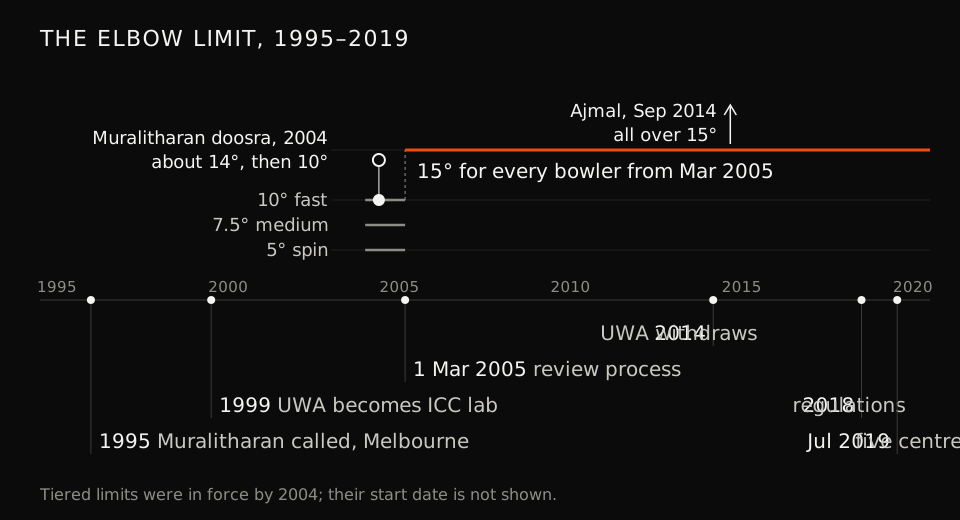
By 2004 the ICC was applying tolerances that varied with bowling style: 5 degrees for spinners, 7.5 for medium pacers and 10 for fast bowlers. Its chief executive, Malcolm Speed, defended the tiers that year on the grounds that different styles of bowler gain an advantage at different levels. Biomechanists, including the authors of the 2004 report on Muttiah Muralitharan’s doosra described below, publicly questioned the spinners’ figure.
The single 15-degree limit for every bowler was agreed in stages. An expert panel of former international players proposed it in October 2004, drawing on research by Marc Portus, Bruce Elliott and Paul Hurrion. The ICC Cricket Committee endorsed it on 9 November 2004, and the ICC Chief Executives’ Committee approved it in February 2005. It came into force on 1 March 2005, together with the review process built around it. The ICC described 15 degrees as the point at which straightening becomes visible to the naked eye, and its current regulations give the same rationale while discounting any hyperextension beyond straight.
| Before March 2005 | Since March 2005 | |
|---|---|---|
| Permitted straightening | Tiered: 5° spinners, 7.5° medium pace, 10° fast | 15° for every bowler, arm horizontal to release; hyperextension discounted |
| Stated rationale | Different styles gain an advantage at different levels | The point at which straightening becomes visible to the naked eye |
| Review route | Six-week first stage after a report; a further report within 12 months went to the ICC’s Bowling Review Group | Report by umpire or referee; independent assessment at an accredited centre, normally within 14 days |
| Sanction | The Bowling Review Group could impose a 12-month ban | Immediate suspension until a re-assessment is passed; a second suspension within two years means at least a year out |
The cases that shaped it, stated carefully
Muttiah Muralitharan’s career runs through this history. Umpire Darrell Hair called him for throwing seven times on the first day of the Boxing Day Test at Melbourne in 1995. A University of Western Australia study published in 2000 found his elbow angle changed little in the 0.06 seconds before release on his off-spin, leg-spin and top-spin deliveries. In 2004 his doosra was reported during the final Test of Australia’s tour of Sri Lanka; a UWA report measured about 14 degrees of straightening, reduced to about 10 after remedial work, against the 5-degree spinners’ tolerance of the time. Sri Lanka Cricket told him not to bowl it in internationals, and the ICC supported that.
Both 2004 figures are below the uniform limit adopted months later. Cricket Australia’s news site, reviewing the history in 2014, noted that Muralitharan was never suspended for an illegal action in his 19-year international career.
The second turning point came in 2014. The University of Western Australia, the ICC’s exclusive testing lab since 1999, withdrew in March; new centres were accredited, and the ICC Cricket Committee encouraged umpires to start reporting suspect actions again. Between June and 13 November eight bowlers were reported and five suspended. The most prominent, Pakistan’s Saeed Ajmal, was tested in Brisbane in August and suspended in September after the ICC found that all his deliveries exceeded 15 degrees. He remodelled his action, was retested in Chennai in January 2015 and was cleared the following month.
A report is a suspicion, not a finding. The regulations require the ICC to announce publicly when a reported bowler is found not to use an illegal action, and a suspension ends as soon as a remodelled action passes re-assessment.
How international cricket polices it today
Under the regulations the ICC currently publishes, in force since 2018, policing starts with the naked eye. An umpire or the match referee may file a report after a match if they suspect a throw, judging from live play or normal-speed video and using slow motion only to confirm a suspicion. For Tests, one-day internationals and T20 internationals the report reaches the team and the ICC within 24 hours, and the ICC then announces that the player has been reported.
The player must undergo an independent assessment at an ICC-accredited centre, normally within 14 days, or within 72 hours if reported at a major ICC event, and may keep bowling until the result arrives. A member of the ICC’s panel of human-movement specialists, preferably from another country, supervises a 3D motion-analysis test with markers on the arm and torso and ICC-supplied calibration tools and software. The bowler replicates the match action off a full run-up and bowls 18 to 36 deliveries, including at least six of any delivery type named in the report; a fast bowler’s stock balls are split between good length, yorker and bouncer.
The specialist reports within 10 days, and a second panel member with no previous involvement validates the report. If any delivery of the bowler’s stock type exceeds 15 degrees, the action is illegal and the suspension is immediate; if only a particular variation fails, the bowler may carry on, warned that bowling it risks a second report, and a second failed test on that variation brings immediate suspension. There is no appeal against the science, only against a failure of procedure. For other international matches, two specialists review video and must agree, and a bowler who disputes their conclusion can take a lab test at their own or their board’s cost, refunded if cleared.
Where bowling actions are tested
The ICC’s regulations list five accredited testing centres: Lahore University of Management Sciences, Loughborough University, Sri Ramachandra University in Chennai, the National Cricket Centre in Brisbane and the University of Pretoria. The ICC named the same five when it accredited the Lahore centre in July 2019, and set out the standard: room for a full run-up and a motion-analysis system with at least 12 high-speed cameras producing 3D data, with ICC-supplied equipment and software to allow consistent assessment across centres.
For Indian players the relevant centre is the Sri Ramachandra Arthroscopy and Sports Sciences Centre in Chennai, which the BCCI names in its own suspect-action policies. Those BCCI documents list a slightly different set of approved centres from the ICC’s, so confirm the current list with your board before arranging anything.
Suspension, remedial work and coming back
A suspension lasts until the bowler passes a re-assessment, which they may request at any time and which follows the same protocol at the player’s or board’s expense; the ICC pays for the initial assessment. A second suspension within two years brings an automatic minimum of one year before re-assessment is allowed. Every national board must enforce an international suspension in its domestic cricket, although a board may choose to let the player keep bowling in its own domestic competitions.
Remedial work is coaching on the whole action, not just the arm. In a study of 48 pathway and elite finger-spinners, those with illegal actions were more front-on and relied on extra elbow flexion; the authors recommended a more side-on position at back-foot impact and rotating the trunk through to release to reduce elbow extension (Spratford and colleagues, 2018).
Domestic, junior and club cricket
In domestic, school and club matches the on-field procedure is the Law itself. Under Law 21.3, if either umpire considers a ball thrown, they call and signal no ball, and the bowler’s-end umpire gives a first and final warning for the innings and tells the fielding captain and the batters. A second throw by the same bowler in that innings brings another no ball and suspension from bowling for the rest of the innings, and the umpires report it after the match to the team’s executive and the governing body.
The ICC requires every national board to run its own procedure for suspect actions in domestic cricket. The BCCI’s league policies, such as the published 2026 Women’s Premier League policy, keep a warning list: a reported player may keep bowling, but a second report while on the list means suspension from all BCCI matches until cleared, and clearance comes from the BCCI Suspect Bowling Action Committee after a 3D analysis at an ICC-approved centre. When the ICC accredited the Chennai and Brisbane centres in 2014, it said they would let domestic and under-age bowlers be tested against the ICC standard before representing their country.
For a young bowler the useful question is whether the elbow straightens across the window, and that can be checked long before an umpire raises it. Stance measures elbow angle across that window from ordinary phone footage — useful for deciding whether formal testing is worth arranging, but not an official ruling. Our guide to checking a bowling action from video sets out how to film and read it.
Common questions
- Is chucking illegal in cricket?
- Yes. Law 21.2 says the ball must not be thrown. An umpire who considers a delivery thrown calls no ball and gives the bowler a first and final warning; a second throw in the same innings means the bowler is suspended for the rest of it. In international cricket a reported bowler is tested in a lab and suspended if the elbow straightens by more than 15 degrees.
- What is the difference between bowling and throwing in cricket?
- Straightening of the elbow. A bowler may deliver with a bent arm provided the elbow does not straighten once the arm has reached shoulder height in the delivery swing. In international cricket, straightening of more than 15 degrees between the arm reaching horizontal and release is treated as a throw. Movement at the wrist is allowed.
- Who decides if a bowler is chucking?
- On the field, the umpires: either can call no ball under Law 21.3. In international cricket, umpires and match referees only report a suspicion. The decision comes from an independent assessment at an ICC-accredited centre, supervised by a human-movement specialist and validated by a second one.
- When did the chucking limit become 15 degrees?
- On 1 March 2005, when a single 15-degree limit for all bowlers came into force with a new review process, replacing the ICC’s tiered limits of 5, 7.5 and 10 degrees. The ICC Cricket Committee had endorsed the change in November 2004, and the ICC Chief Executives’ Committee approved it in February 2005. The ICC’s current regulations, in force since 2018, keep the same limit.
- Can a bowler return after being suspended for chucking?
- Yes. A suspended bowler can apply for a re-assessment at any time, usually after remedial work on the action, and may bowl again as soon as a validated report finds the remodelled action legal. A second suspension within two years means a minimum of one year before re-assessment is allowed.
- Was Muttiah Muralitharan ever suspended for his bowling action?
- No. He was called for throwing by umpire Darrell Hair in Melbourne in 1995, and in 2004 a University of Western Australia report on his doosra led Sri Lanka Cricket to tell him not to bowl that delivery while the 5-degree spinners’ limit applied. Cricket Australia’s news site notes he was never suspended for an illegal action in his 19-year international career.
Sources
- MCC Laws of Cricket — Law 21: No ball (21.2 Fair delivery – the arm; 21.3 action by umpires)
- ICC — Illegal bowling actions
- ICC — Regulations for the review of bowlers reported with suspected illegal bowling actions (PDF)
- ICC — 2004 statement on Muttiah Muralitharan’s doosra and the tiered tolerance levels
- ICC — 2004 statement: the Cricket Committee endorses one 15-degree limit for all bowlers
- ICC — 2005 statement: the new illegal deliveries process, including the 15-degree limit, takes effect on 1 March 2005
- ICC — Lahore becomes an accredited testing centre (2019; lists all five centres)
- The Cricket Monthly (ESPNcricinfo), Osman Samiuddin — “Let’s talk about flex” (2014)