How to play the cover drive: technique, faults and drills
By Rishi Gupta and Pradaksh Prasun · Published · Updated
A cover drive is a front-foot shot that sends a full ball pitched on or just outside off stump through the covers, between point and mid-off for a right-hander. To play it, step your front foot towards the pitch of the ball, lead with your head and front shoulder, keep your head over the ball and swing the full face of the bat through the line, finishing balanced over a bent front knee.
When to play the cover drive
The cover drive is a front-foot drive to a ball pitched up outside off stump. ESPNcricinfo’s coaching guide treats it as the wider version of the off drive: an over-pitched ball on off stump is driven either side of mid-off, but if it is slightly wider the front foot moves in the direction of the shot, to the left or right of cover. A ball not full enough to drive calls for the forward defence; one short of a length belongs to the back foot.
The width that makes the shot possible also makes it risky. A drive at a ball that is too wide or not full enough means reaching away from the body, and the edge carries to the slips. Wisden reported in 2024 that bowlers had targeted Virat Kohli beyond the fourth-stump line to force him to drive, and that he had nicked off in eight of his last ten dismissals in South Africa, England, New Zealand and Australia.
The reward is real too. In 503 sixes hit in men’s international one-day and T20 cricket, half volleys and balls outside off stump produced more sixes on the off side than expected (Jamil and colleagues, 2022). Against spin, New Zealand Cricket recommends the off and straight drives early in an innings and the cover drive once set. The other drives are compared in types of shots in cricket.
How to play a cover drive, step by step
- Set up balanced and still. Feet about shoulder-width apart, knees slightly flexed, weight on the balls of the feet, eyes level and head turned to the bowler. Stances vary — coach Gary Palmer teaches a more open, chest-on set-up — but whatever you choose must let you move forward or back.
- Use a small trigger, then wait. In one study, 70% of skilled batters made a preparatory foot movement before committing forward, against 20% of less-skilled batters (Taliep and colleagues, 2007). The trigger gets you moving; it is not a decision to play forward.
- Watch the ball from the hand. Keep the head still and the eyes level at release and read the length before you stride. International batters delay the stride and the downswing to take in more of the ball’s flight (Stuelcken and colleagues, 2005).
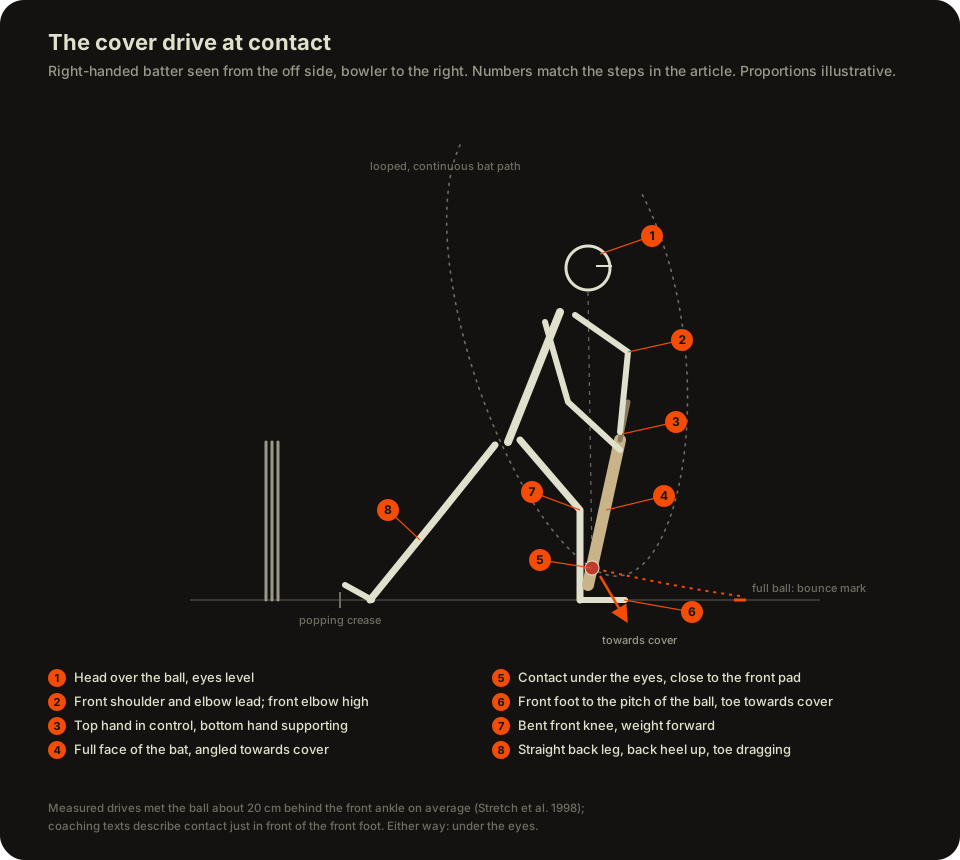
- Lead with the head and front shoulder. Step the front foot towards the pitch of the ball, toe angled towards where you want to hit it, with the front shoulder and elbow leading. Kohli’s cue, from an IPL masterclass reported by ESPNcricinfo: “Your head should always be where your toe is.”
- Bring the bat down in one continuous loop. The backlift naturally comes from the direction of the slips; let the bat loop at the top and come down without stopping. Analysis of international batters found a distinctly looped bat path and a continuous flow from backswing into downswing.
- Meet the ball under your eyes, close to your body. Strike with the full face, with the head over the ball and the weight on the front foot. In an instrumented-bat study the top hand did most of the work in the drive, with the bottom hand reinforcing it at impact (Stretch and colleagues, 1998).
- Let the top hand and front elbow steer. ESPNcricinfo’s guide says the top hand and elbow control the direction of the shot; New Zealand Cricket asks for a shoulder shape that lets the hands come through in line with the intended direction, towards cover.
- Finish balanced. Bent front knee, straight back leg, a stable base, and the bat continuing over the front shoulder or checked at shoulder height with the face open. If the ball is fuller than you expected, Kohli’s advice is to collapse the back leg rather than bend further on the front.
What biomechanics research says about the drive
A match study filmed nine right-handed international batters playing off-side front-foot drives in first-class and international cricket. They delayed the front stride and downswing to take in more of the ball’s flight, and the front-arm segments worked as one unit, peaking in speed almost together just before impact. The bat followed a distinctly looped path, the front foot landed only just before impact, and the front ankle sat well inside the line of the ball. The authors noted that the stride timing and bat path may challenge some long-held coaching beliefs (Stuelcken, Portus and Mason, 2005).
An earlier study of 14 provincial batters compared the drive with the forward defence. The drive used a higher backlift (0.74 m against 0.65 m) and a slightly shorter stride (0.68 m against 0.72 m), though neither difference was statistically significant; the front foot landed about 0.06 s before impact, and the bat was far faster: about 11.8 m/s just before impact against 3.5 m/s. Contact came on average about 20 cm behind the front ankle, with the bat closer to vertical (78° against 63°) (Stretch and colleagues, 1998).
Skill shows in the head and the timing. Skilled batters kept the head further forward of the centre of their base throughout a shadow off drive, which went with a centre of mass further forward at contact; shoulder angle, bat angle and bat speed did not differ from less-skilled batters (Taliep and colleagues, 2007). In another study, highly skilled batters started and finished the front-foot stride earlier, more closely synchronised the end of the stride with the start of the downswing, and timed the downswing consistently relative to the bounce (Weissensteiner, Abernethy and Farrow, 2011).
Evidence on power comes from lofted straight drives. In 20 batters from club to international standard hitting for distance against a bowling machine, pelvis–thorax separation at the start of the downswing, lead-elbow extension and wrist uncocking explained 78% of the variation in bat speed, and impact location with bat speed explained 68% of ball speed (Peploe and colleagues, 2019). Middling matters: impacts within about 2 cm of the sweet spot across the face and 4.5 cm along it cost less than 6% of ball speed and under 10° of direction (Peploe and colleagues, 2018).
Head stability and watching the ball
Batters do not follow the whole flight smoothly. Eye tracking showed that they look at the ball at release, make a predictive eye movement to where they expect it to bounce, then follow it for 100–200 ms after the bounce; a short delay before that first movement separated good batters from poor ones (Land and McLeod, 2000).
The head does much of the tracking. Two international batters facing deliveries at 120 km/h kept their heads pointed closer to the ball than two club batters (an average head–ball angle of 2.4° against 3.7°, and a maximum of 10.7° against 20.6°), and on good-length balls their gaze coincided with bat–ball contact in every trial, against 13% for the club batters (Mann, Spratford and Abernethy, 2013). Four batters is a very small sample, but it fits the coaching cue: a still, level head that moves with the ball rather than away from it.
That is why head movement between release and contact is the first thing batting technique analysis checks.
Common cover drive faults and how to fix them
Most cover drive faults start before the bat moves: a head that drifts, a foot that commits too early, or a ball never full enough to drive. Fix the cause, one thing at a time.
Keep the cue on the ball, not your body. Thirteen skilled batters playing straight drives made worse contact and took shorter strides when told to focus on their hands than when told to focus on the ball’s flight (Bull and colleagues, 2023).
| Fault | What you see | Likely cause | Fix | Source |
|---|---|---|---|---|
| Playing away from the body | Hands reach out to the ball, a gap between bat and pad, edges to the slips or gully | Front foot short of the pitch or line of the ball; driving at width | Get the front foot to the pitch and line, meet the ball under the eyes close to the body, and leave balls too wide to reach | ESPNcricinfo coaching; Kohli via ESPNcricinfo 2016; Wisden 2024 |
| Head falling over | Head drifts outside the line or drops; the batter topples towards the off side after contact | Head not leading the stride; over-reaching | Lead with the head and front shoulder; head over the front toe at contact; hold the finish | ESPNcricinfo coaching; New Zealand Cricket; Taliep 2007 |
| Closed face | Ball goes straighter than intended or off the leading edge | Bottom hand dominating and turning the face early | Let the top hand and front elbow control the direction; present the full face towards cover | ESPNcricinfo coaching; Stretch 1998; ESPNcricinfo 2016 |
| Early commitment | Front foot planted before the length is clear; stuck forward to a shorter ball | Pre-deciding to drive | Trigger, then wait; let the front foot land just before contact | Stuelcken 2005; Weissensteiner 2011 |
| Over-striding | Very long stride, weight stuck between the feet, head behind the front knee | Reaching for a ball not full enough | Stride to the pitch, not past it; to a fuller ball, collapse the back leg rather than bending further on the front | Kohli via ESPNcricinfo 2016; New Zealand Cricket |
| Ball lofted by accident | Drives carry in the air to cover | Contact too far in front of the front foot, or the head lifting early | Meet the ball under the eyes, close to the front foot; keep the head down through contact | ESPNcricinfo coaching (off and lofted drive) |
Drills for the cover drive
Start off a tee. New Zealand Cricket’s target-driving drill sets two cones 15 metres in front of a batting tee and 5 metres apart; the batter scores a run for every drive between them, then progresses to underarm feeds. Its coaching points are the drive in miniature: stand side-on, step with the foot beside the ball, swing down straight with the full face, keep the head still and point the shoulders at the target. For the cover drive, set the gate between cover and extra cover.
Isolate the footwork with a drop feed. In a drill Graham Thorpe described to Wisden, a feeder drops the ball a few feet in front of the batter, who comes forward and hits it on the second bounce; for the cover drive, drop it slightly outside off stump. Coach Gary Palmer’s “Four Angles” drill — mid-on, straight, mid-off and extra cover — teaches the cover drive as part of a range rather than a party piece.
Then face real bowling. Developing batters timed the stride and downswing differently against a bowling machine than against a bowler at the same speed (Pinder, Renshaw and Davids, 2009), so use the machine for volume and a bowler for timing. Film a set of drives each session from the same position, so you compare like with like.
Virat Kohli’s cover drive: what he and analysts have said
Kohli has described the shot himself. In an IPL masterclass reported by ESPNcricinfo in 2016, he said the head should be where the toe is, so the ball is met close to the body and head and stays under control. If the ball pitches beyond the reach of the front foot, he plays it alongside the pad with a follow-through that keeps it on the ground; to a fuller ball, he collapses the back foot rather than bending more on the front.
ESPNcricinfo’s Alagappan Muthu noted that off-side drives depend on the top hand for timing and direction, which is harder for a bottom-handed player like Kohli; in T20 cricket he often moved well outside leg stump to make room for the bottom hand to do the work. Wisden reported that after the 2014 tour of England he moved to a more side-on stance with his toe pointing towards point rather than cover, and his average against balls in the channel outside off stump rose from 28 in his first four years of international cricket to 92.
His method is not a template, but the principles match the research: head over the front foot, contact close to the body.
What you can measure from phone video
Two angles cover most of the drive. Side-on, square of the pitch, shows stride length and timing, front-knee flexion at contact, whether the head is over the front foot and how upright the bat is at impact. From in front, filmed from behind a net down the pitch, the camera shows whether the head drifts across the line, the path of the bat and where the front foot lands relative to the ball.
Film at 60 fps or faster. The front foot lands about 0.06 s before impact in the drive, which is under two frames at 30 fps and about four at 60 fps. The measurement that matters most is how much the head moves between release and contact; batting technique analysis explains how that, the base, trunk rotation and sequencing are read shot by shot, and Stance measures them from phone footage.
Know the limits. A single camera measures movement across its view well and movement towards the lens poorly, as cricket biomechanics from video explains, so compare drives with drives over several sessions rather than judging one shot.
Common questions
- What is a cover drive in cricket?
- A front-foot drive that sends a full ball pitched outside off stump through the cover region, between point and mid-off for a right-hander, usually along the ground. It is the wider version of the off drive: the front foot steps towards the pitch of the ball and in the direction of the shot, and the full face of the bat is swung through the line.
- What is the difference between a cover drive and an off drive?
- The line of the ball and the direction of the stride. The off drive is played to an over-pitched ball on or just outside off stump and goes either side of mid-off. When the ball is slightly wider, the front foot moves towards cover and the same stroke becomes a cover drive. The straight drive goes back past the bowler with the front foot pointing down the pitch.
- Is the cover drive hard to play?
- It is one of the riskier drives because it is played to balls outside off stump: misjudge the width or length and the ball takes the edge to the slips, which is exactly how bowlers try to dismiss even Virat Kohli. Played to a genuinely full ball that the front foot can reach, with the head over the ball, it is a controlled shot.
- How do you play a lofted cover drive?
- Use the same footwork, with the front foot going towards the pitch of the ball, but meet the ball further from the front toe and follow through fully to clear the infield. ESPNcricinfo’s coaching guide warns against lifting the head too early and against letting the weight fall onto the back foot; stay balanced on both feet at impact.
- How can I improve my cover drive?
- Work on one thing at a time: get the front foot to the pitch, keep the head over the ball and let the top hand steer. Drill it off a tee and with drop feeds before facing bowling, and mix machine work with real bowlers. Film from side-on and from in front so you can check the head, stride and base rather than relying on feel.
- How do you play a cover drive like Virat Kohli?
- Kohli’s own cue is to keep the head where the toe is, so the ball is met close to the body and head. To a fuller ball he collapses the back leg rather than bending more on the front. Wisden reported that after 2014 he moved to a more side-on stance with his toe pointing towards point, which improved his record outside off stump.
Sources
- ESPNcricinfo coaching — Batting: off drive (and cover drive)
- ESPNcricinfo coaching — Batting: stance
- ESPNcricinfo coaching — Batting: backlift
- ESPNcricinfo coaching — Batting: lofted drive
- New Zealand Cricket — Development Coaching Course e-manual, Section 2: Batting (PDF)
- New Zealand Cricket — Superstarter skills cards, Years 7 & 8 (target driving) (PDF)
- Stuelcken, Portus & Mason (2005) — Off-side front foot drives in men’s high performance cricket, Sports Biomech
- Stretch, Buys, Du Toit & Viljoen (1998) — Kinematics and kinetics of the drive off the front foot in cricket batting, J Sports Sci
- Taliep, Galal & Vaughan (2007) — The position of the head and centre of mass during the front foot off-drive in skilled and less-skilled cricket batsmen, Sports Biomech
- Weissensteiner, Abernethy & Farrow (2011) — Hitting a cricket ball: what components of the interceptive action are most linked to expertise?, Sports Biomech
- Peploe, McErlain-Naylor, Harland & King (2019) — Relationships between technique and bat speed, post-impact ball speed, and carry distance during a range hitting task in cricket, Hum Mov Sci
- Peploe, McErlain-Naylor, Harland & King (2018) — The relationships between impact location and post-impact ball speed, bat torsion, and ball direction in cricket batting, J Sports Sci
- Land & McLeod (2000) — From eye movements to actions: how batsmen hit the ball, Nat Neurosci
- Mann, Spratford & Abernethy (2013) — The head tracks and gaze predicts: how the world’s best batters hit a ball, PLoS One
- Bull, Atack, North & Murphy (2023) — The effect of attentional focus instructions on performance and technique in a complex open skill, Eur J Sport Sci
- Pinder, Renshaw & Davids (2009) — Information-movement coupling in developing cricketers under changing ecological practice constraints, Hum Mov Sci
- Jamil et al. (2022) — The effects of bowling lines and lengths on the spatial distribution of successful power-hitting strokes in international men’s one-day and T20 cricket, J Sports Sci
- Alagappan Muthu, ESPNcricinfo (2016) — Cover drive vaults bottom-handed Virat Kohli to top of T20 run charts
- Sarah Waris, Wisden (2024) — Virat Kohli’s rigidity with technique is a bigger concern than his returns
- Phil Walker, Wisden (2017) — How to play straight (Gary Palmer’s batting method)
- Wisden — Learn from the pros: take your batting to the next level with Graham Thorpe (2018)