Fastest bowler in the world: the fastest recorded balls in cricket history
By Rishi Gupta and Pradaksh Prasun · Published · Updated
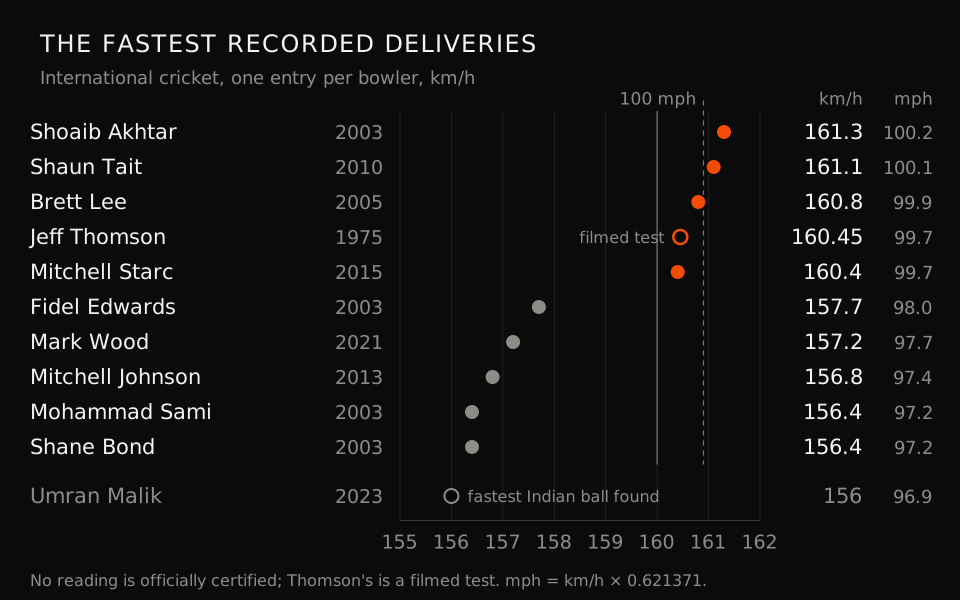
The fastest bowler in the world by recorded speed is Pakistan’s Shoaib Akhtar: 161.3 km/h (100.2 mph) against England at Newlands on 22 February 2003, the fastest delivery Guinness World Records recognises. Shaun Tait (161.1 km/h, 2010) and Brett Lee (160.8 km/h, 2005) come next. The ICC has never certified a speed record, because speed guns vary.
The fastest balls ever recorded
Five bowlers have been reliably timed at 160 km/h (99.4 mph) or faster, and on the figures we use, two of them passed 100 mph (160.9 km/h). Akhtar’s 161.3 km/h ball to Nick Knight at Newlands on 22 February 2003 is the delivery Guinness World Records lists as the fastest electronically measured. Shaun Tait’s 161.1 km/h at Lord’s in 2010, the fifth ball of an over that Andrew Strauss glanced for a single, is still the fastest by an Australian.
Mitchell Starc’s 160.4 km/h yorker to Ross Taylor at the WACA in Perth in November 2015 is the fastest ball recorded in a Test match, according to Guinness. Jeff Thomson’s 160.45 km/h is the odd one out: it was filmed with high-speed cameras in a special session at the WACA in December 1975, not bowled in a match, so it is not a like-for-like reading.
No governing body keeps a database of bowling speeds, so this table is built from figures published by Guinness, Wisden, ESPNcricinfo and major news organisations, checked against match-day reports where we could find them. Each bowler appears once. Below about 158 km/h, a list compiled from other sources could include other names, and the next section explains why even the order at the top is argued over.
| Bowler | Speed, km/h (mph) | Match or event | Year | Source |
|---|---|---|---|---|
| Shoaib Akhtar (Pakistan) | 161.3 (100.2) | World Cup v England, Newlands, Cape Town, 22 February | 2003 | Guinness World Records |
| Shaun Tait (Australia) | 161.1 (100.1) | ODI v England, Lord’s | 2010 | ABC News (2025); Sky Sports (2020); Wisden (2020) |
| Brett Lee (Australia) | 160.8 (99.9) | ODI v New Zealand, Napier, 5 March | 2005 | ESPNcricinfo and New Zealand Herald match-day reports (2005); Wisden (2020) |
| Jeff Thomson (Australia) | 160.45 (99.7) | High-speed camera test at the WACA, Perth, December (not a match ball) | 1975 | ESPNcricinfo records, citing Dennis Lillee’s The Art of Fast Bowling; Wisden CricInfo (2002) |
| Mitchell Starc (Australia) | 160.4 (99.7) | Second Test v New Zealand, WACA, Perth, 15 November | 2015 | Guinness World Records (fastest Test ball) |
| Fidel Edwards (West Indies) | 157.7 (98.0) | v South Africa | 2003 | Wisden (2020) |
| Mark Wood (England) | 157.2 (97.7) | Test v Australia, Melbourne | 2021 | The Telegraph (2024), from ball-tracking data |
| Mitchell Johnson (Australia) | 156.8 (97.4) | Fourth Ashes Test v England, day three, December | 2013 | Wisden (2020); Sky Sports (2020) |
| Mohammad Sami (Pakistan) | 156.4 (97.2) | ODI v Zimbabwe | 2003 | Wisden (2020) |
| Shane Bond (New Zealand) | 156.4 (97.2) | World Cup | 2003 | Wisden (2020) |
| Umran Malik (India), for reference | 156 (96.9) | First ODI v Sri Lanka, Guwahati, 10 January | 2023 | ANI, via Gulf News (2023) |
Why the ‘fastest ball’ is disputed
The ICC does not certify bowling speeds. Guinness, while recognising Akhtar’s 161.3 km/h, quotes the ICC’s position that speed guns around the world are not uniform enough for any one performance to be made official. The question first arose in April 2002, when Akhtar was timed at 161 km/h (100.04 mph) against New Zealand in Lahore. That reading came from a sponsor’s radar, used because the host broadcaster’s gun was out of order, and an ICC spokesman said the council had never kept official records of bowling speeds and would not ratify it.
Thomson’s 1975 figure is a different kind of measurement. ESPNcricinfo gives his 160.45 km/h as a release speed filmed with high-speed cameras at 200 and 400 frames per second, and Wisden CricInfo described the session in 2002 as a special net session rather than match conditions. The 160.6 km/h often quoted for Thomson appears to come from a radar ‘fastest bowler’ competition the following year. The same 1975 session is the source of Andy Roberts’ 159.5 km/h, but ESPNcricinfo’s records page and a 2013 ESPNcricinfo feature disagree about it: the feature credits both 159.49 and 160.45 km/h to Thomson and puts Roberts at 150.67 km/h.
Modern readings vary too. On the day of Brett Lee’s fastest ball, at Napier in March 2005, ESPNcricinfo and the New Zealand Herald both reported 160.8 km/h; later lists and profiles often give 161.1 km/h, which would tie him with Tait.
And instruments make mistakes. In IPL 2013 the big screen showed Morne Morkel at 173.9 km/h; Hawk-Eye, which supplied the tracking, said the ball should have been in the 140s, and the BCCI said it had been told the error was human. Gerald Coetzee was shown at 157.4 km/h in April 2024, a reading later reported as a technical error. In December 2024 a broadcast glitch at Adelaide credited Mohammed Siraj with 181.6 km/h. Even the women’s record is contested: Shabnim Ismail’s 132.1 km/h in the Women’s Premier League in March 2024, the first women’s delivery recorded above 130 km/h, first appeared as 138.3 km/h, and Wisden argued it should not be taken at face value.
Another came at Perth on 19 October 2025, when Mitchell Starc’s opening delivery to Rohit Sharma in the first ODI against India was shown at 176.5 km/h on the speed gun. Reports put it down to a technical error, and Gulf News reported that officials confirmed the speed gun had malfunctioned. The table below lists the readings of this kind that we could verify.
The practical rule: treat any single reading as an estimate, compare speeds only when they come from the same system, and assume a figure far above 161 km/h is a fault.
| Bowler | Reading shown | Match | What happened | Source |
|---|---|---|---|---|
| Brett Lee | 161.8 km/h | v West Indies, Brisbane, 23 November 2000 | Put down to external interference with the radar’s signal; two back-up radars recorded 142 km/h | Cricinfo, bowling speeds: other reports |
| Morne Morkel | 173.9 km/h | IPL 2013, Royal Challengers Bangalore v Delhi Daredevils | Hawk-Eye said the ball should have been in the 140s; the BCCI said it had been told the error was human | Financial Express (2013); ThePapare (2013) |
| Gerald Coetzee | 157.4 km/h | IPL, Mumbai Indians v Rajasthan Royals, April 2024 | Reported as a technical error | IANS (2 April 2024) |
| Mohammed Siraj | 181.6 km/h | Second Test v Australia, Adelaide, December 2024 | A technical glitch | The Week (2024) |
| Mitchell Starc | 176.5 km/h | First ODI v India, Perth, 19 October 2025 | Put down to a technical error; Gulf News reported that officials confirmed the speed gun had malfunctioned | WION (19 October 2025); Gulf News (19 October 2025) |
| Shabnim Ismail | 138.3 km/h | Women’s Premier League, March 2024 | Adjusted to 132.1 km/h, which the ICC reported as the first women’s ball above 130 km/h; Wisden argued even that should not be taken at face value | ICC (2024); Wisden (2024) |
How bowling speed is measured
Two systems produce the speeds shown on television. A radar gun bounces radio waves off the ball and works out its speed from the change in frequency, the Doppler effect. Camera systems such as Hawk-Eye track the ball from several angles and calculate its speed from its position in successive frames, the same data used for ball-tracking.
Broadcast speeds are release speeds, taken at the fastest point of the ball’s flight. During IPL 2013, Hawk-Eye said its four cameras captured an average of 72 frames of each delivery and used the first two, before friction slows the ball, to calculate speed. From there the ball slows: Sky Sports’ statistician Benedict Bermange gives the example of a ball released at about 90 mph (145 km/h) travelling at about 80 mph (129 km/h) before it pitches and about 72 mph (116 km/h) after. How fast a cricket ball is when it reaches the batter sets that example beside a physicist’s estimate.
Radar has known weaknesses. It reads the ball’s speed along its own line of sight, so a gun that is off-line reads low — the cosine effect explained in our guide to bowling speed apps and radar guns. In a 2002 Cricinfo article, Hawk-Eye’s creator Paul Hawkins said that radar also gives a faster reading for a full-length ball than for a short one, and that its readings cannot be checked afterwards, whereas a camera system keeps the images. England’s ball-tracking speed records go back to 2006, according to The Telegraph.
Phone video usually measures something else again. Counting frames between release and arrival, which our bowling speed calculator turns into km/h and mph, gives the ball’s average speed over its flight, and that reads lower than a broadcast release speed. Automatic trackers, Stance among them, calibrate distance from the regulation size of the stumps rather than a pitch length you type in. Whatever the method, check whether a figure is a release speed or an average before comparing it with a Test-match reading; measuring bowling speed from video explains the set-up.
Fastest ball in IPL history
The IPL has no published all-time speed table, and its early seasons are patchy: ESPNcricinfo described Anrich Nortje’s 156.22 km/h in 2020 as the fastest delivery the league logged between 2012 and 2020. These are the fastest IPL deliveries we could verify.
Shaun Tait, Rajasthan Royals v Delhi Daredevils, April 2011: ESPNcricinfo’s match report says one of the balls in his first over to Aaron Finch touched 157 km/h. Widely shared lists give 157.71 km/h, a figure we could not trace to an official record.
Lockie Ferguson, Gujarat Titans v Rajasthan Royals, 2022 final: 157.3 km/h (97.7 mph), a yorker that beat Jos Buttler, according to Wisden.
Umran Malik, Sunrisers Hyderabad v Delhi Capitals, 5 May 2022: 156.9 km/h by ESPNcricinfo’s figure (157 km/h in other reports), hit for four by Rovman Powell.
Mayank Yadav, Lucknow Super Giants v Royal Challengers Bengaluru, 2024: 156.7 km/h in only his second IPL match, the fastest ball recorded that season according to ESPNcricinfo, after 155.8 km/h on debut.
Anrich Nortje, Delhi Capitals v Rajasthan Royals, Dubai, October 2020: 156.22 km/h (97.1 mph).
Gerald Coetzee’s 157.4 km/h for Mumbai Indians in April 2024 is often added to these lists, but it was reported as a technical error.
India’s fastest bowlers, and how fast they usually bowl
No Indian bowler has been reliably timed at 160 km/h. The fastest international ball by an Indian that we found is Umran Malik’s 156 km/h against Sri Lanka in Guwahati on 10 January 2023, reported by ANI, which beat the 155 km/h he had bowled in the first T20I of the same series. His 156.9 km/h in IPL 2022 is the fastest Indian figure in the IPL that we could verify. In Cricinfo’s unofficial list of international speeds from the late 1990s and early 2000s, the fastest Indian was Javagal Srinath, at 149.6 km/h.
Typical speeds say more about a bowler than one fastest ball. The figures below come from tracking data reported by Wisden, ESPNcricinfo and ANI; each is a snapshot of the series named.
Jasprit Bumrah: in the 2025 Test series in England, about 40% of his deliveries reached 140 km/h or more at Headingley and about 27% at Lord’s, but only one of 173 did at Old Trafford, according to ANI. Wisden reported in April 2026 that at least 35% of his IPL deliveries had reached 140 km/h in each of the previous three seasons, against 9.9% early in IPL 2026. Raw speed undersells him: ESPNcricinfo’s analysis puts his release point about 50 cm closer to the batter than other top bowlers’.
Mohammed Siraj: having bowled on 18 of the 25 days of the 2025 series in England, the 1,122nd ball he sent down, at The Oval, was clocked at 143 km/h (89 mph), his fifth-fastest of the series (ESPNcricinfo).
Mohammed Shami: in IPL 2023, about 40% of his deliveries were faster than 140 km/h, about 58% between 130 and 140 km/h and only about 2% slower than 130 km/h (ESPNcricinfo).
Mayank Yadav: on his India debut against Bangladesh in Gwalior in October 2024, his fastest ball was 149.9 km/h and his median 144.4 km/h, with 17 of 24 balls above 140 km/h; slower balls pulled his average down to 138.7 km/h (Wisden). On his international comeback against Zimbabwe in Harare in 2026, ten of his first 12 balls were in the mid-to-high 140s and his fastest was 149 km/h (ESPNcricinfo).
What counts as fast, and could anyone bowl 170 km/h?
There is no official speed classification. Cricinfo’s long-running speed list, which calls its own thresholds arbitrary, treats 140 km/h as the mark of a fast bowler, above 145 km/h as a genuine speedster and 150 km/h as express pace. Club and pathway bowlers are far slower; our guide to average bowling speed by age collects the measured figures.
Few bowlers have ever passed 160 km/h, and ABC News reported in 2025 that fewer are getting close. The biomechanics researcher Rene Ferdinands told ABC that coaching has steered bowlers away from the side-on action used by Thomson, Akhtar and Tait, and that the 160 km/h mark was unlikely to be broken without changes to coaching. South Australia’s under-19 coach Luke Butterworth said gym and technical work might add roughly 5–10 km/h, but that top pace depends on natural attributes such as height and running ability.
No delivery has been reliably measured at 170 km/h. The readings that high that we know of were instrument faults, and Thomson’s belief that he was close to 180 km/h out of the hand, reported by Guinness, was never measured. For what the research says actually adds pace, see how to increase bowling speed.
Km/h to mph conversion table
Speeds on this page are in km/h, as ESPNcricinfo and Wisden report them; British outlets such as Sky Sports and The Telegraph often quote mph. To convert, multiply km/h by 0.621371 (one mile is exactly 1.609344 km); to go back, multiply mph by 1.609344. So 100 mph is 160.9 km/h, and 150 km/h is 93.2 mph.
The last column shows how long a ball would take to cover 18.5 m, roughly the distance from release to the batter’s stumps on a full pitch, if it kept its speed. Real deliveries slow after release, so they take a little longer.
| km/h | mph | m/s | Seconds to cover 18.5 m |
|---|---|---|---|
| 100 | 62.1 | 27.8 | 0.666 |
| 105 | 65.2 | 29.2 | 0.634 |
| 110 | 68.4 | 30.6 | 0.605 |
| 115 | 71.5 | 31.9 | 0.579 |
| 120 | 74.6 | 33.3 | 0.555 |
| 125 | 77.7 | 34.7 | 0.533 |
| 130 | 80.8 | 36.1 | 0.512 |
| 135 | 83.9 | 37.5 | 0.493 |
| 140 | 87.0 | 38.9 | 0.476 |
| 145 | 90.1 | 40.3 | 0.459 |
| 150 | 93.2 | 41.7 | 0.444 |
| 155 | 96.3 | 43.1 | 0.430 |
| 160 | 99.4 | 44.4 | 0.416 |
| 165 | 102.5 | 45.8 | 0.404 |
Common questions
- Who is the world’s no. 1 fastest bowler?
- By recorded speed, Shoaib Akhtar of Pakistan: his 161.3 km/h (100.2 mph) against England at the 2003 World Cup is the fastest delivery Guinness World Records recognises. Shaun Tait (161.1 km/h, 2010) and Brett Lee (160.8 km/h, 2005) are within half a km/h. There is no official ranking, because the ICC does not certify bowling speeds.
- Who bowled 160 kmph?
- Five bowlers have been reliably timed at 160 km/h or more: Shoaib Akhtar (161.3 km/h, 2003), Shaun Tait (161.1 km/h, 2010), Brett Lee (160.8 km/h, 2005), Jeff Thomson (160.45 km/h in a filmed test in 1975) and Mitchell Starc (160.4 km/h, 2015, the fastest Test ball). No Indian bowler has; the fastest Indian figure we could verify is Umran Malik’s 156.9 km/h in IPL 2022.
- What was Bumrah’s fastest ball?
- We could not find it in a primary record. Reporting Umran Malik’s new Indian record in January 2023, ANI gave Bumrah’s previous mark for an Indian in international cricket as 153.36 km/h; other reports say 153.6. His usual pace is lower: about 40% of his balls reached 140 km/h at Headingley in 2025, according to ANI.
- Has anyone ever bowled 170 kmph?
- No. The readings above 170 km/h that have made the news were errors: Hawk-Eye said Morne Morkel’s 173.9 km/h in IPL 2013 should have been in the 140s, and Mohammed Siraj’s 181.6 km/h at Adelaide in 2024 was a broadcast glitch. The fastest recognised ball is 161.3 km/h. Jeff Thomson has said he was close to 180 km/h out of the hand, but that was never measured.
- Who bowled 181 kmph?
- Nobody. On the first day of the second Test between Australia and India at Adelaide in December 2024, the broadcast speed gun showed 181.6 km/h for Mohammed Siraj’s last ball of the 25th over, which Marnus Labuschagne hit for four. It was a technical glitch, about 20 km/h faster than the 161.3 km/h world record.
- Which bowlers have bowled 100 mph?
- 100 mph is 160.9 km/h. Shoaib Akhtar’s 161.3 km/h (100.2 mph) at Newlands in 2003 is the recognised record; his 161 km/h (100.04 mph) in Lahore in 2002, timed on a sponsor’s radar, was never ratified. Shaun Tait reached 161.1 km/h (100.1 mph) at Lord’s in 2010. Brett Lee’s fastest was reported at 160.8 km/h (99.9 mph) at the time, though some later lists give 161.1 km/h.
- Did Mitchell Starc break Shoaib Akhtar’s record?
- No. Starc’s opening delivery to Rohit Sharma in the first ODI against India at Perth on 19 October 2025 was shown at 176.5 km/h, but it was a speed-gun error: Gulf News reported that officials confirmed the speed gun had malfunctioned. His fastest ball recognised by Guinness is 160.4 km/h, the fastest ball bowled in a Test match, at the WACA in November 2015. Akhtar’s 161.3 km/h from 2003 remains the fastest delivery Guinness World Records recognises.
Sources
- Guinness World Records — Fastest delivery of a cricket ball (male): Shoaib Akhtar, 161.3 km/h, 22 February 2003
- Guinness World Records — Fastest ball bowled in a Test match: Mitchell Starc, 160.4 km/h, 15 November 2015
- Cricinfo — International bowling speeds (compiled by Eddie Smith; unofficial)
- Cricinfo — Bowling speeds: other reports (1975 WACA camera study, 1976 study)
- ESPNcricinfo (2013) — The pace race between Shoaib Akhtar, Brett Lee and others in the early 2000s
- Wisden CricInfo (29 April 2002) — ICC will not ratify Shoaib record
- Cricinfo (2 May 2002) — Ralph Dellor, The 100 mph ball: did he or didn’t he?
- ESPNcricinfo (5 March 2005) — Brett Lee unleashes his fastest delivery (on ESPN.com)
- New Zealand Herald (6 March 2005) — Lightning Lee upsets line-up
- ABC News (20 April 2025) — Will we ever see fast bowlers deliver cricket balls above 160kph again?
- ABC News (15 November 2015) — Mitchell Starc bowls one of the fastest balls ever recorded
- Sky Sports (23 October 2020) — Benedict Bermange, Who is cricket’s fastest ever bowler?
- Wisden (December 2020) — The ten fastest bowlers in cricket history
- The Telegraph, via Yahoo Sports (25 July 2024) — Will Macpherson on Mark Wood’s speeds
- ESPNcricinfo (April 2011) — Rajasthan Royals v Delhi Daredevils, IPL match report
- Wisden (29 May 2022) — Lockie Ferguson’s 157.3 kph, the fastest ball of IPL 2022
- ESPNcricinfo (5 May 2022) — Umran Malik records fastest ball of IPL 2022, 156.9 kph (on ESPN.com)
- Gulf News / AFP (15 October 2020) — Anrich Nortje clocks 156.22 kph
- ESPNcricinfo — Mayank Yadav player profile
- ESPNcricinfo — Mumbai Indians v Rajasthan Royals, IPL 2024, ball-by-ball commentary (1 April 2024)
- Gulf News / ANI (10 January 2023) — Umran Malik clocks 156kph in 1st ODI against Sri Lanka
- Wisden (6 October 2024) — How fast did Mayank Yadav bowl on his India debut?
- ESPNcricinfo (23 July 2026) — Fitter, faster, smarter: Mayank Yadav 2.0 unleashed
- ANI (26 July 2025) — These stats show decline in Bumrah’s bowling speed
- Wisden (20 April 2026) — Rahul Iyer, Jasprit Bumrah clearly isn’t fully fit
- ESPNcricinfo (20 July 2025) — The magician’s wrist: how Bumrah does what he does
- ESPNcricinfo (4 August 2025) — Vithushan Ehantharajah on the final day at The Oval (on ESPN.com)
- ESPNcricinfo (22 May 2023) — Sidharth Monga on Mohammed Shami in IPL 2023 (on ESPN.com)
- Financial Express (18 April 2013) — Morne Morkel’s 173.9 kmph, and Hawk-Eye’s explanation
- The Week (7 December 2024) — Did Mohammed Siraj’s ball clock 181.6 kmph at Adelaide?
- ICC (March 2024) — Shabnim Ismail shatters record with fastest delivery ever in women’s cricket
- Wisden (6 March 2024) — Did Shabnim Ismail really break the 130kph barrier?
- NIST Special Publication 811, Appendix B.9 — conversion factors (1 mph = 1.609344 km/h)
- Gulf News (19 October 2025) — Jai Rai, Did Mitchell Starc break Shoaib Akhtar’s fastest delivery record — or didn’t he?
- WION (19 October 2025) — IND vs AUS: Did Mitchell Starc bowl the fastest ball in cricket history? Here’s what we know
- IANS (2 April 2024) — Mayank Yadav bowls fastest delivery of the season at 156.7 kmph (Gerald Coetzee’s 157.4 reported as a technical error)
- ThePapare (21 April 2013) — Did Morne Morkel bowl a 173.9kph scorcher at IPL? (Hawk-Eye’s comments to The Indian Express)