Spin bowling types and grips: finger spin, wrist spin and every main delivery
By Rishi Gupta and Pradaksh Prasun · Published
Spin bowling comes in two families. Finger spinners — off-spinners and left-arm orthodox bowlers — spin the ball mainly with their fingers; wrist spinners — leg-spinners and left-arm wrist spinners — add a flick of the wrist. From a right-arm bowler, the off-break turns into a right-handed batter and the leg-break turns away.
Finger spin and wrist spin: the two families
Seen from the bowler’s end, a right-arm finger spinner’s stock ball deviates to the right after landing and a right-arm wrist spinner’s to the left; left-armers reverse both (Ferdinands and colleagues, 2023). For a right-handed batter that means the off-break turns in, from off to leg, and the leg-break turns away. Left-arm orthodox is finger spin with the left hand, and left-arm wrist spin is the left-handed version of leg spin (Kerruish and colleagues, 2025).
The labels are historical rather than exact — fingers and wrist work in both (Ferdinands and colleagues, 2023) — but the techniques differ. In 3D motion capture of 23 off-spinners and 20 leg-spinners, the off-spinners had a shorter stride and a lower spin rate, while the leg-spinners approached faster and flexed the elbow as the arm accelerated, where most off-spinners extended it; the authors called for separate coaching models (Beach and colleagues, 2016).
Finger spin dominates Test cricket. Of the 72 full-time spinners with at least 100 Test wickets, only 15 bowled wrist spin exclusively, and ESPNcricinfo’s Karthik Krishnaswamy calls it the most complicated and error-prone way to deliver a cricket ball: what it gains in revolutions and bite off the pitch it often loses in control (Krishnaswamy, 2025).
| Delivery | Bowler type | Turns, to a right-hander | Grip and release cue | Source |
|---|---|---|---|---|
| Off-break | Right-arm finger spinner (off-spinner) | In, from off to leg | Index and middle fingers spread wide across the seam; the fingers spin the ball rather than the wrist rolling it | Freeman 1938; Mallett 2017 |
| Arm ball | Off-spinner or left-arm orthodox | Straight on, often drifting in the air | Stock action, released so the ball does not turn; Mallett pointed the seam towards square leg | Kerruish 2025; Mallett 2017 |
| Doosra | Right-arm finger spinner | Away, from leg to off | Off-break action with a tweak of thumb and forefinger; more shoulder, elbow and wrist movement than the off-break | Vasu 2011; Chin 2009 |
| Carrom ball | Finger spinner | Either way — the middle finger decides; mostly used to turn it away | Flicked out of the front of the hand between the thumb and a bent middle finger | ESPNcricinfo 2013; Kerruish 2025; Samiuddin 2024 |
| Leg-break | Right-arm wrist spinner (leg-spinner) | Away, from leg to off | First two fingers round the seam, ball resting on the third finger, thumb steadying; seam pointing towards slip | Freeman 1938; Gollapudi 2021 |
| Googly (wrong’un) | Wrist spinner | In, from off to leg | Same grip; wrist turned over so the ball leaves over the little finger, from the back of the hand | Freeman 1938; Kerruish 2025 |
| Top-spinner | Wrist spinner | Straight on, with extra dip | Same grip; seam pointing straight down the pitch, released halfway between leg-break and googly | Freeman 1938; Atherton; Beach 2012 |
| Flipper | Wrist spinner | Straight on, skidding through | Squeezed out from under the hand between thumb and finger, with back-spin | Atherton; ESPNcricinfo 2013; Gollapudi 2021 |
| Slider | Wrist spinner | Straight on | Pushed out of the front of the hand between the second and third fingers | Atherton; Mallett 2017 |
| Left-arm orthodox stock ball | Left-arm finger spinner | Away, from leg to off | Mirror image of the off-break | Kerruish 2025; Ferdinands 2023 |
| Left-arm wrist-spin stock ball | Left-arm wrist spinner | In, from off to leg | Mirror image of the leg-break, bowled over the wrist | ESPNcricinfo 2007; Kerruish 2025 |
Finger-spin deliveries: off-break, arm ball, doosra and carrom ball
The off-break is the finger spinner’s stock ball. Jim Laker spread his index and middle fingers wide apart across the seam, a grip that lets both fingers spin the ball (Mallett, 2017). The fingers do the work: the Kent leg-spinner Tich Freeman, in a 1938 interview, said an off-spinner who merely turns the wrist is “rolling the ball — no more”, and that the ball should be flicked with the fingers as it leaves the hand (Freeman, 1938).
The arm ball is the straight one, meant to go on with the arm off the pitch, often after drifting in the air (Kerruish and colleagues, 2025). There is no single method. Mallett kept his off-break grip but delivered the ball with the seam pointing towards square leg, so that it hit the pitch and skidded on straight, much like a leg-spinner’s ball from the front of the hand (Mallett, 2017).
The doosra — Hindi and Urdu for “second” or “the other one” — was the first ball to turn away off the pitch from an off-break action. Saqlain Mushtaq mastered it first, and Anand Vasu put it down to a tweak of the thumb and forefinger (Vasu, 2011). In the laboratory it was bowled with larger ranges of shoulder horizontal rotation, elbow extension and wrist extension than the off-break, a longer stride and a lower release point (Chin and colleagues, 2009).
The carrom ball is flicked out of the front of the hand (Kerruish and colleagues, 2025) by the thumb and a bent middle finger, which decides which way it turns; it takes extraordinarily strong fingers. Jack Iverson introduced it to Test cricket after the Second World War, and Ajantha Mendis revived it (ESPNcricinfo, 2013). Since 2015, most of the balls off-spinners have turned away from right-handers have been carrom balls, according to analysis by Nathan Leamon and Ben Jones cited by Samiuddin (2024).
Wrist-spin deliveries: leg-break, googly, top-spinner, flipper and slider
For the leg-break, Freeman held the ball with the first and second fingers round the seam, the ball resting on the third finger, the thumb steadying it and the seam pointing towards slip (Freeman, 1938). Rashid Khan’s main grip is similar: the tips of the index and middle fingers grip the seam at about 10 and 2 o’clock, perpendicular to it, with the ring finger at about 8 o’clock (Gollapudi, 2021).
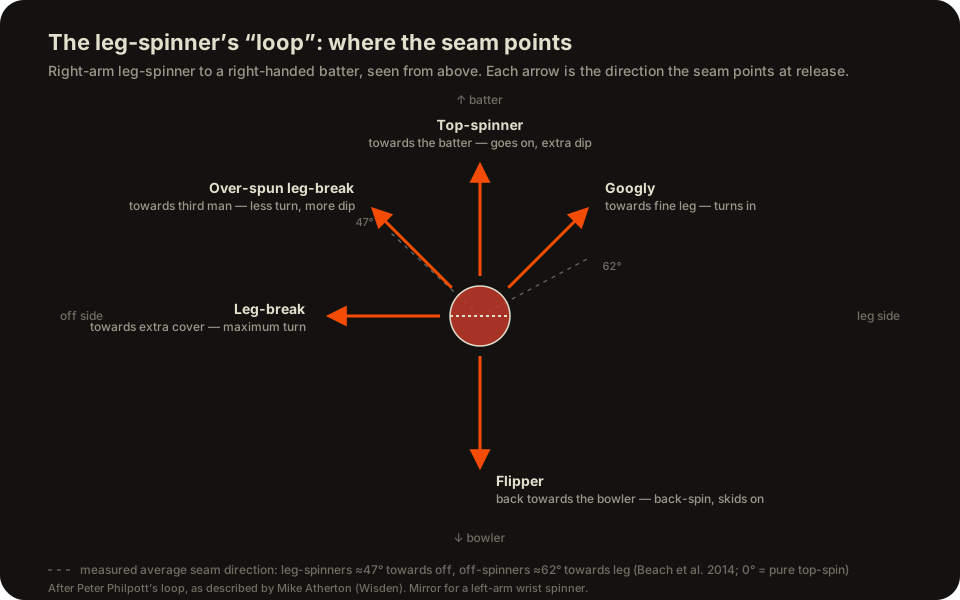
The variations come mostly from the wrist, not a new grip. Freeman held the googly and the top-spinner exactly as he held the leg-break (Freeman, 1938). The former New South Wales leg-spinner Peter Philpott called the sequence going “through the loop”: a leg-break with pure side-spin has the seam rotating towards extra cover, for maximum turn; adding over-spin turns the seam towards third man, with less turn but more dip and bounce; the top-spinner’s seam rotates towards the batter, and the googly’s towards fine leg (Atherton, Wisden).
For the googly — invented by B.J.T. Bosanquet, and also called the wrong’un or bosey — the wrist is turned over and the ball comes out over the little finger, from the back of the hand (Freeman, 1938; Atherton, Wisden; Mallett, 2017). For the top-spinner, Freeman pointed the seam straight down the pitch and released the ball halfway between his leg-break and googly positions.
The flipper is the opposite of the top-spinner: squeezed out from under the hand between thumb and finger, it carries back-spin, the seam rotating back towards the bowler (Atherton, Wisden; ESPNcricinfo, 2013). Clarrie Grimmett is credited with perfecting it. The slider is pushed out of the front of the hand between the second and third fingers (Atherton, Wisden), and a leg-spinner’s ball from the front of the hand hits the pitch and skids on straight (Mallett, 2017).
Left-arm orthodox and left-arm wrist spin
Left-arm orthodox is finger spin bowled with the left hand. Its stock ball turns away from a right-handed batter, from leg to off, and into a left-hander; the arm ball is its straight one (Kerruish and colleagues, 2025). ESPNcricinfo lists Ravindra Jadeja as a slow left-arm orthodox bowler.
Left-arm wrist spin is the mirror image of a right-armer’s leg-break: bowled over the wrist, it turns into the right-hander and away from the left-hander, and its googly does the opposite. It is as hard to control as leg spin (ESPNcricinfo, 2007). ESPNcricinfo announced in 2021 that it had dropped the old nickname “chinaman” because it is an ethnic slur, and describes what Kuldeep Yadav bowls as left-arm wristspin (Bal, 2021). We use “left-arm wrist spin” too.
Handedness shapes how each is used. In 23,084 balls from six elite T20 competitions, spin turning away from the batter — off spin to left-handers, left-arm orthodox to right-handers — conceded runs less often, while against right-handers off-spinners and left-arm orthodox bowlers had about 20% lower odds per ball of taking a wicket than right-arm leg-spinners (Kerruish and colleagues, 2025).
What makes spin effective: revolutions, speed, drift and dip
A spinning ball deviates twice: in the air, through the Magnus force, and off the pitch, through friction (Ferdinands and colleagues, 2023). The aerial effects are drift, a sideways curve, and dip, a late increase in the rate of descent. Side-spin gives more turn off the pitch, top-spin less turn but more drop, and a tilted spin axis makes the ball swerve. In ten club and state bowlers, two leg-spinners tilted the axis the opposite way to the norm — none of the off-spinners did — and the authors concluded that a leg-spinner can potentially swerve the ball either way (Beach and colleagues, 2012).
Revolutions separate playing levels most consistently. Elite off-spinners delivered the off-break at 26.7 revolutions per second against 22.2 for a high-performance group, and at 75.1 against 67.1 km/h (Chin and colleagues, 2009). England’s national spinners averaged 29.5 rev/s against 25.9 for development-squad bowlers (Justham and colleagues, 2008, as reported by Beach and colleagues, 2012). Twenty-three elite English finger spinners produced 1,432–2,143 revolutions per minute — about 24–36 rev/s — at 17.7–23.4 m/s, roughly 64–84 km/h (Sanders, Felton and King, 2018). In an Australian study of 56 elite and pathway spinners, release speed and revolutions discriminated playing level, and wrist spinners put more revolutions on the ball (Spratford and colleagues, 2018).
Wrist spin buys revolutions at a cost in control. District-level leg-spinners averaged 29.3 rev/s against 25.0 for off-spinners at the same ball speed, about 67 km/h (Beach and colleagues, 2014). In elite T20 the leg-spinner’s stock ball was more likely to be scored off than the off-break, while the googly and the carrom ball were the most effective variations against right-handers: per ball, the googly had about 72% higher odds of a wicket than the off-break, the carrom ball about twice the odds (Kerruish and colleagues, 2025).
Revolutions are not everything. Clarrie Grimmett told Mallett that a ball on a flat path below the batter’s eyeline shows exactly where it will land, while one spun hard and arriving above the eyeline does not (Mallett, 2017).

How the body produces revolutions
In the 23 elite English finger spinners, pelvis orientation was the strongest predictor of spin rate, explaining about 43% of its variation. The bowlers with most revolutions had the pelvis mid-way at front-foot contact and rotating past front-on by release, a larger separation between pelvis and shoulders, and shoulders just short of side-on — on the same side-on-to-front-on scale used for fast bowling action types. The segments then rotated in sequence, from the pelvis to the pronation of the forearm (Sanders, Felton and King, 2018).
That cuts against the textbook model of turning from side-on to front-on over a braced front knee: neither run-up speed nor front-knee extension was related to spin rate (Sanders, Felton and King, 2018), and district-level off-spinners released the ball with the front knee still bent (Beach and colleagues, 2014).
Forearm rotation differs too: finger spin is usually bowled with the forearm supinating and wrist spin with it pronating, but some bowlers do the opposite — Type 1 and Type 2 spin, in researchers’ terms (Ferdinands and colleagues, 2023).
Legality: the doosra and the elbow
Spinners face the same rule as everyone else. Law 21.2 forbids straightening the elbow once the arm has reached shoulder height, but expressly allows the bowler to flex or rotate the wrist (MCC, Law 21). In international cricket the ICC treats more than 15 degrees of extension between the arm reaching horizontal and release as illegal (ICC). Why a bent arm is not itself a throw is explained in the 15-degree elbow rule.
The doosra is where finger spinners run into trouble, because turning the ball the other way from an off-break action asks more of the elbow and wrist (Chin and colleagues, 2009). Four of the top ten Test off-spinners in the decade to 2015 bowled it, and all four faced questions over their actions; when Saeed Ajmal was tested in 2014, every one of his 37 deliveries exceeded 15 degrees (Samiuddin, 2024). The doosra is not banned, but it is now rare: 51 of 23,521 spin deliveries in the elite T20 sample above (Kerruish and colleagues, 2025). Muttiah Muralitharan’s doosra and the old 5-degree spinners’ limit are covered in our chucking explainer.
Off-spinners generally extend the elbow more than leg-spinners. District-level off-spinners tended to extend it through delivery, some beyond 15 degrees, while leg-spinners flexed it (Beach and colleagues, 2014). Elite English finger spinners extended theirs by only 0–10.5 degrees, and within that range more extension did not mean more spin (Sanders, Felton and King, 2018). Beyond the limit it does help: pathway finger spinners with illegal actions matched elite legal bowlers for speed and revolutions, relying on a more front-on body and extra elbow flexion and supination (Spratford and colleagues, 2018). To screen your own action, see how to check if a bowling action is legal.
Common faults, and what phone video can measure
1. Rolling instead of spinning: the wrist turns but the fingers do not flick, giving the ball a gentle release rather than a real tweak (Freeman, 1938; Mallett, 1997).
2. A flat trajectory below the batter’s eyeline, which lets the batter read the length early (Mallett, 2017).
3. Spinning before landing it: Freeman insisted that length be commanded before any attempt at spin (1938), and uncontrolled leg spin is expensive (Kerruish and colleagues, 2025).
4. Over-using a variation: bowlers stripped the doosra of its mystery by relying on it too much (Samiuddin, 2024), while Freeman took many wickets by not bowling his googly (1938).
5. Bowling front-on and leaning on extra elbow flexion, the pattern found in illegal finger-spin actions (Spratford and colleagues, 2018).
Phone video can measure much of the body and some of the ball: release speed, as in measuring bowling speed from video; stride length relative to height, 46% of stature for off-spinners and 52% for leg-spinners in one study (Beach and colleagues, 2014); pelvis and shoulder positions, within the single-camera limits described in cricket biomechanics from video; and the elbow angle across the release window, filmed side-on to the bowling arm. Stance measures run-up and delivery-stride mechanics, ball speed and that elbow angle from ordinary phone clips — information about the action, not an official ruling.
Revolutions are harder. Laboratories use radar, markers on the ball or instrumented balls (Sanders, Felton and King, 2018; Spratford and colleagues, 2018; Ferdinands and colleagues, 2023). By our arithmetic, a ball spinning at 28 rev/s turns about 42° between frames at 240 frames per second but about 168° at 60, so at ordinary frame rates the seam cannot be followed reliably.
Common questions
- What are the different types of spin bowling?
- There are two families. Finger spin — right-arm off spin and left-arm orthodox — spins the ball mainly with the fingers; wrist spin — right-arm leg spin and left-arm wrist spin — adds a flick of the wrist and usually more revolutions. Finger spinners’ variations include the arm ball, doosra and carrom ball; wrist spinners’ include the googly, top-spinner, flipper and slider.
- What is the difference between a googly and a doosra?
- Both turn the opposite way to the bowler’s stock ball, but they come from different families. The googly is a wrist spinner’s ball, bowled with the leg-break grip but out of the back of the hand, and it turns into a right-hander. The doosra is a finger spinner’s ball that turns away from a right-hander from an off-break action; it asks more of the elbow, which is why it attracts legality scrutiny.
- Did the ICC ban the doosra?
- No. The doosra is legal provided the elbow straightens by no more than 15 degrees between the arm reaching horizontal and release — the same limit as every other delivery. It became rare after the 2014 crackdown on suspect actions, when Saeed Ajmal was banned from bowling after every one of his 37 deliveries in testing exceeded the limit, and the other leading doosra bowlers of the previous decade had also faced questions over their actions.
- Why is leg spin difficult?
- Because the wrist and fingers have to spin the ball hard and still land it accurately. Wrist spin produces more revolutions — about 29 per second against 25 for off-spinners in one study — but ESPNcricinfo’s analysis calls it the most complicated and error-prone way to bowl, and in elite T20 data the leg-spinner’s stock ball was scored off more often than the off-break.
- Is Jadeja a leg-spinner or an off-spinner?
- Neither, strictly. ESPNcricinfo lists Ravindra Jadeja as a slow left-arm orthodox bowler — a finger spinner who bowls with his left hand. His stock ball is the mirror image of an off-break: it turns away from right-handed batters and into left-handers.
- Which is better, off spin or leg spin?
- Neither outright. In 23,084 balls of elite T20 cricket, right-arm leg-spinners were the most likely to dismiss right-handed batters, while spin turning away from the batter — off spin to left-handers, left-arm orthodox to right-handers — conceded runs less often. Leg spin produces more revolutions; off spin is easier to control. Teams pick spinners partly on match-ups.
Sources
- Kerruish, McRobert & Jamil (2025) — Leg spin or off spin? Orthodox or unorthodox? Bowling–batting match-ups and the effectiveness of spin variations in international and franchise T20 cricket, Eur J Sport Sci
- Ferdinands, Doljin & Fuss (2023) — Identification, taxonomy and performance assessment of Type 1 and Type 2 spin bowling deliveries with a smart cricket ball, Sensors
- Beach, Ferdinands & Sinclair (2012) — Measuring spin characteristics of a cricket ball, ISBS Proceedings
- Beach, Ferdinands & Sinclair (2014) — The kinematic differences between the leg-spin and off-spin bowling techniques in cricket, ISBS Proceedings
- Beach, Ferdinands & Sinclair (2016) — The kinematic differences between off-spin and leg-spin bowling in cricket, Sports Biomech
- Chin et al. (2009) — The off-break and “doosra”: kinematic variations of elite and sub-elite bowlers in creating ball spin in cricket bowling, Sports Biomech
- Sanders, Felton & King (2018) — Kinematic parameters contributing to the production of spin in elite finger spin bowling, J Sports Sci (accepted manuscript)
- Spratford et al. (2018) — Does performance level affect initial ball flight kinematics in finger and wrist-spin cricket bowlers?, J Sports Sci
- Spratford et al. (2018) — Illegal bowling actions contribute to performance in cricket finger-spin bowlers, Scand J Med Sci Sports
- A.P. “Tich” Freeman (1938) — Spin bowling (interview), republished by ESPNcricinfo
- Ashley Mallett (2017) — on the offspinner’s variations, ESPNcricinfo
- Ashley Mallett (1997) — A spin-doctor writes, ESPNcricinfo
- Nagraj Gollapudi (2021) — Rashid Khan talks us through his bowling grips and variations, ESPNcricinfo
- ESPNcricinfo (2013) — Mystery and magic: Iverson, Ramadhin, Gleeson and Mendis
- Mike Atherton — Shane Warne: a genius craftsman and an entertainer, Wisden Almanack (republished 2019)
- Anand Vasu (2011) — The doosra, ESPNcricinfo
- Osman Samiuddin (2024) — Ten years since the end of Saeed Ajmal and the doosra, ESPNcricinfo
- Karthik Krishnaswamy (2025) — Where have all the wristspinners gone in Test cricket?, ESPNcricinfo
- ESPNcricinfo (2007) — Leggie in the mirror (left-arm wrist spin explained)
- Sambit Bal (2021) — Why we’re replacing “batsman” with “batter” (and retiring “chinaman”), ESPNcricinfo
- ESPNcricinfo — Ravindra Jadeja player profile (bowling style)
- MCC Laws of Cricket — Law 21: No ball (21.2 Fair delivery – the arm)
- ICC — Illegal bowling actions